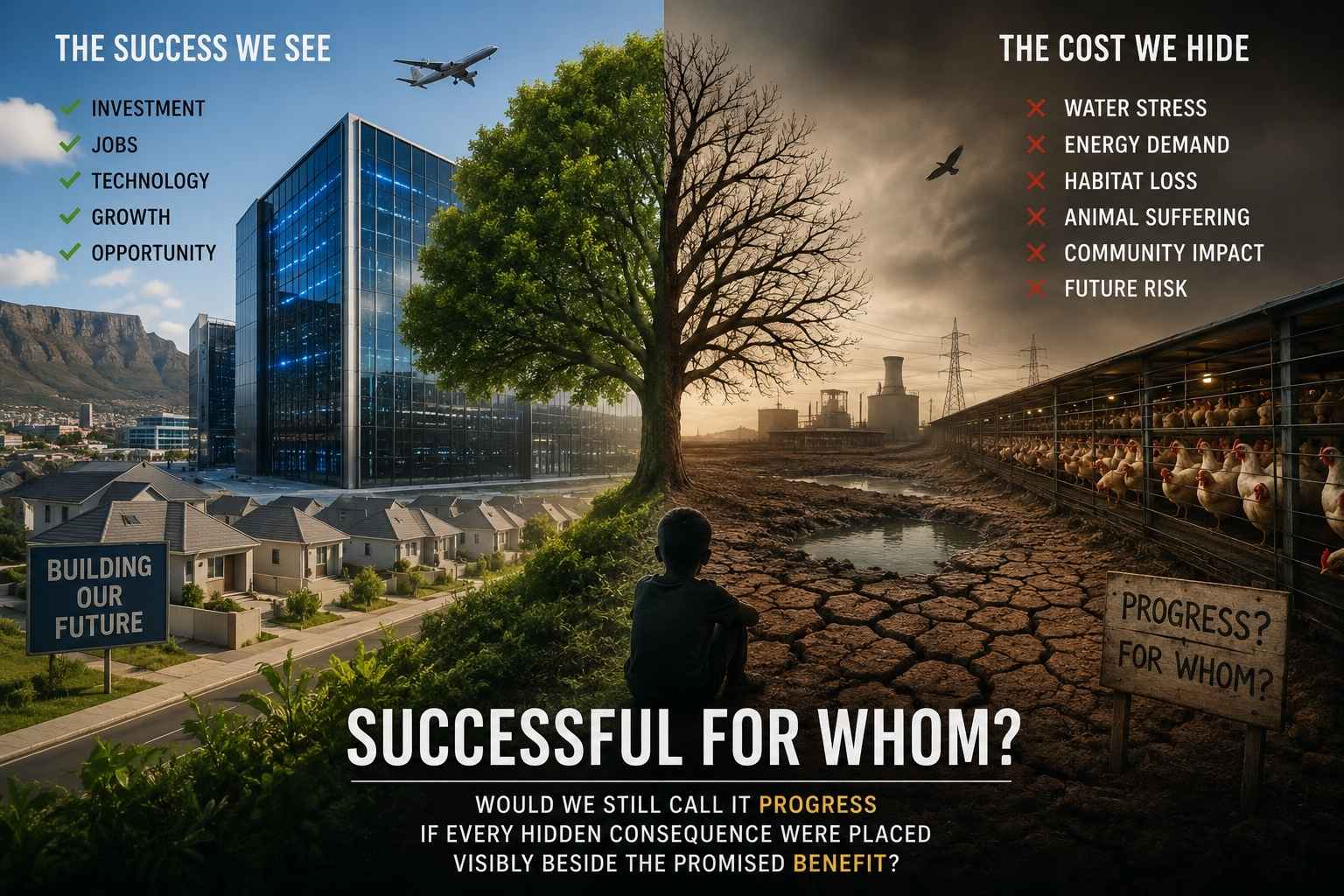
Two large data centres proposed near Cape Town International Airport have received land-use approval amid concerns about electricity demand, water use and their wider environmental impact. Together, the facilities are expected to require roughly 170 megawatts of power. Important operational detail may only become clearer when the site development plans are submitted.
That is the immediate story.
But beneath it sits a larger question.
Who are we becoming when development itself becomes an unquestioned good?
The argument for the centres will be compelling.
Africa needs digital infrastructure.
AI requires computing capacity.
The project may create economic activity.
The city must remain globally competitive.
Every statement may contain truth.
Yet something can be economically rational inside one frame and profoundly irrational inside a larger one.
The data centre grows.
The city attracts investment.
The technology sector expands.
The property earns a return.
The development is declared successful.
But the aquifer does not attend the planning meeting.
The electricity grid has no political voice.
The birds, insects, soil and surrounding communities do not arrive carrying investment projections.
They are present.
They simply do not carry equal weight inside the objective.
The anthill
Elon Musk once used an analogy to describe why artificial intelligence would not need to hate humanity in order to harm us.
When people build a road and an anthill lies in the way, they do not necessarily hate the ants. The road simply matters more. The ants become incidental to the objective.
Musk was warning that a sufficiently powerful intelligence might one day treat humanity in the same way.
But perhaps we should ask whether we are already behaving like the intelligence he warned us about.
We consume the water because infrastructure is needed.
We remove vegetation because economic growth is needed.
We confine chickens because food and profit are needed.
Each objective can be defended.
The incoherence begins when we isolate the objective from everything it touches.
Successful for whom?
A poultry business grows from a handful of chicks into a large commercial operation. From one perspective, it is a story of discipline, reinvestment, scale and success.
But the image may also show hundreds of chickens living inside a confined system built around production.
The owner may not be cruel. The conditions may simply have become normal.
That is how desensitisation works.
The employee becomes headcount.
The patient becomes a case.
The citizen becomes a voter.
The land becomes an available site.
The water becomes a resource allocation.
Language creates distance. Distance reduces feeling. Reduced feeling makes incoherence easier to live with.
The system appears successful because the cost carried by the life within it has been left outside the story.
A system is not truly successful simply because it is profitable. It is successful when the life within it is not diminished in order to sustain the appearance of progress.
Housing versus grass?
Affordable housing presents a more difficult version of the same question because people genuinely need homes.
Cape Town has severe housing pressure, limited well-located land and a historic spatial structure that leaves many poorer residents far from work and opportunity.
But the question is not simply:
It is:
How do we house people without steadily destroying the ecological systems that make the city habitable?
Trees, wetlands, grasslands and open soil are not decorative leftovers waiting for a more profitable use.
They cool the city. They slow and absorb water. They protect soil. They shelter other forms of life. They soften the effects of heat-retaining concrete.
When those systems disappear, the cost may not appear immediately in a development report.
Heat.
Water scarcity.
Species loss.
Overloaded infrastructure.
Psychological disconnection.
A city may technically accommodate more people while becoming increasingly hostile to life.
Everyone is doing their job
We often speak as though someone, somewhere, is taking the whole into account.
But who?
The politician is measured on investment, housing numbers and elections.
The company is measured on profitability and expansion.
The planner works within legislation and technical criteria.
The resident desperately needs somewhere affordable to live.
The consumer wants employment, affordable food and immediate digital services.
Each person may be behaving reasonably within their fragment.
Yet the total system becomes unreasonable.
That is collective incoherence: almost everyone fulfilling their role while the whole moves in a direction nobody consciously chose.
What have we left outside the frame?
Returning to coherence is not primarily about becoming morally perfect.
It is about recovering our ability to perceive relationship.
The water is part of the data centre.
The wetland is part of the housing calculation.
The child behind the closed door is part of the church’s moral record.
The person excluded by doctrine is part of the religion’s fruit.
The citizen carrying the consequence is part of the government’s success.
We have divided reality into categories so that we can celebrate one outcome without feeling its entire cost.
That does not mean automatically rejecting data centres, housing, agriculture or technology.
It means widening the frame before declaring something progress.
What will this consume?
What will it displace?
Who carries the cost if the assumptions are wrong?
What will be restored in return for what is removed?
Does this development increase the coherence of the whole living system—or does it create visible benefit by exporting invisible costs elsewhere?
This is not anti-development.
It is not anti-technology.
It is not an attempt to romanticise the past.
It is an invitation to notice the fragmented consciousness through which something can appear successful only because much of its true cost has been made invisible.
And perhaps that is the real danger of our age.
Not that we have stopped progressing.
But that we have stopped asking what our progress is becoming.
See the whole picture.
The Inside Code explores the patterns beneath people, organisations and systems—especially what becomes visible when we stop reading each part in isolation.
Sources and context
- Reuters: South Africa tribunal approves Equinix data centres despite activist objections
- City of Cape Town: Water Outlook, June 2025
The article distinguishes confirmed project information from the wider questions it raises. Detailed site development and final operating information may change as the planning process continues.